Scaling Amazon PPC is easy if the only goal is more ad-attributed sales.
Increase budgets. Raise bids. Expand targeting. Revenue can move quickly.
The difficult part is finding additional sales without paying too much for them.
When I look at a campaign that is already working, the first question is not "How much more budget can we give it?"
It is:
Can this campaign take more spend at an acceptable incremental cost?
That distinction matters because a campaign can be profitable today and still be a poor candidate for aggressive scaling.
Start With Product Economics
Before increasing spend, establish what the product can actually afford to spend on advertising.
Suppose an ASIN sells for $40.
After COGS, Amazon fees, fulfillment, returns allowance, and other variable costs, suppose it contributes $14 before advertising.
A simplified break-even ACoS would be:
$14 ÷ $40 = 35%
Now assume the campaign produces:
- Spend: $3,000
- Ad sales: $10,000
- ACoS: 30%
The campaign is below that simplified break-even point.
That still does not tell me to increase the budget.
I would first check whether the campaign has more profitable demand to capture and what happened when spend increased previously.
The useful distinction is:
profitable today versus scalable at the same economics.
What Makes a Campaign Scalable?
I want to see several things together:
- Consistent conversion
- Relevant traffic
- Acceptable ACoS or ROAS
- Enough search or product demand
- Stable inventory
- Competitive pricing
- A detail page that converts
- Evidence that more spend can produce more sales
A campaign doing $200 in monthly sales at 20% ACoS is not automatically a better scaling opportunity than one doing $20,000 at 27% ACoS.
There needs to be enough demand to buy.
There also needs to be enough evidence that the next layer of spend will work.
Find the Constraint Before Changing Anything
This is the part I would check first in an account.
| What I see | Likely constraint | What I would check |
|---|---|---|
| Campaign repeatedly reaches its daily budget and keeps converting | Budget | Budget allocation and sales after the budget cap |
| Campaign has budget but spends very little | Bid, targeting, or demand | Impression volume, CPC, target coverage |
| Core targets are efficient but volume is capped | Demand | Search terms, product targets, new relevant targets |
| Clicks are coming in but CVR is weak | Retail conversion | Price, offer, reviews, listing, inventory |
| Spend increases but marginal ACoS deteriorates | Efficiency | Which targets and placements absorbed the extra spend |
| Strong demand but low inventory | Supply | Inventory cover and replenishment |
Do not change the bid just because sales are flat.
First work out why sales are flat.
Do Not Increase Every Campaign by the Same Percentage
A blanket budget increase is easy to execute and difficult to justify.
Consider four campaigns:
| Campaign | ACoS | Sales | Budget status | What I would do |
|---|---|---|---|---|
| A | 21% | $18,000 | Out of budget | Investigate additional budget |
| B | 24% | $9,000 | Out of budget | Investigate additional budget |
| C | 35% | $7,000 | Spending fully | Diagnose before scaling |
| D | 52% | $3,000 | Underspending | Fix targeting or conversion first |
Campaign A may have room to grow.
Campaign D does not become a scaling opportunity just because the account owner decides to increase every budget by 20%.
The decision should follow the campaign's constraint.
The Metric I Watch During Scaling: Marginal ACoS
Average ACoS tells you what happened across the campaign.
It does not tell you what the next $1,000 will produce.
Consider this:
Before scaling
- Spend: $5,000
- Sales: $20,000
- ACoS: 25%
After increasing spend:
After scaling
- Spend: $8,000
- Sales: $28,000
- ACoS: 28.6%
The campaign still looks reasonable from the average ACoS.
But the additional $3,000 in spend produced $8,000 in additional sales.
Marginal ACoS:
$3,000 ÷ $8,000 = 37.5%
That tells me something the 28.6% average does not.
The campaign may still be profitable overall while the latest spend is becoming harder to justify.
For an actual scaling decision, I would also check contribution margin. Marginal ACoS is useful, but it is not a substitute for product economics.
Budget and Bids Solve Different Problems
If a campaign is profitable and repeatedly runs out of budget, budget may be the constraint.
If it has plenty of budget but is not getting enough relevant traffic, I would investigate bids, targeting, and available demand.
Increase budget when
- The campaign repeatedly reaches its daily budget
- Traffic converts at an acceptable rate
- Additional demand exists
- The campaign is already producing profitable sales
Investigate bids when
- Budget is available
- Spend is below the budget
- Impression volume is limited
- Target economics are strong
- More auction coverage could produce useful sales
Expand targeting when
- Core targets are already mature
- Existing targets have limited incremental volume
- Search-term data shows relevant queries outside the current structure
- Product targeting has additional opportunities
Fix conversion when
- Traffic is healthy
- CPC is reasonable
- Conversion has weakened
- Price, offer, reviews, inventory, or the detail page is creating friction
A budget increase cannot fix a conversion problem.
A bid increase cannot fix a campaign that is already limited by its daily budget.
Scale at the Target Level
Campaign averages hide a lot.
Suppose a campaign contains:
- 5 highly profitable exact targets
- 20 average targets
- 15 expensive targets
The campaign ACoS can look fine.
Increasing bids across the entire campaign can still push more money into the expensive targets.
For a scaling decision, I would:
- 1Identify targets producing profitable sales.
- 2Check whether those targets have more impression opportunity.
- 3Increase bids selectively where the economics support it.
- 4Isolate or reduce inefficient targets.
- 5Reallocate budget toward proven opportunities.
As the account grows, target-level and search-term analysis becomes more important because campaign averages become less useful for individual decisions.
Watch Placement Before Raising the Base Bid
A campaign can look average overall while one placement is doing most of the useful work.
For example:
| Placement | Spend | Sales | ACoS |
|---|---|---|---|
| Top of Search | $2,000 | $8,000 | 25% |
| Rest of Search | $1,500 | $4,000 | 37.5% |
| Product Pages | $1,000 | $1,500 | 66.7% |
If Top of Search is producing stronger economics and there is still demand available, that is a better scaling question than simply raising the base bid.
A base bid increase can put additional spend into placements that are already performing poorly.
Amazon's current Sponsored Products setup also supports placement bid adjustments, so placement performance should be evaluated separately when deciding where additional spend should go.
Watch for Diminishing Returns
Scaling often starts well.
Then the pattern changes:
More spend → broader traffic → higher CPC → weaker conversion → higher marginal ACoS
The first dollars can capture your strongest opportunities.
Additional spend may come from weaker queries, weaker placements, or more expensive auctions.
Watch for:
- CPC rising
- CVR falling
- ACoS increasing
- Incremental sales slowing
- Marginal ACoS moving above your acceptable range
That does not automatically mean the campaign is bad.
It can simply mean you are reaching the current limit of its profitable demand.
Use Guardrails Before You Scale
Set the boundaries before making the change.
For example:
- Target ACoS: 25%
- Maximum acceptable ACoS: 35%
- Minimum CVR: 10%
- Maximum CPC: $2
- Minimum inventory cover: 30 days
These are examples, not universal benchmarks.
The useful part is having a predefined point at which you stop and diagnose.
Otherwise, it is easy to keep increasing spend because total sales are still going up.
Do Not Scale Into an Inventory Problem
PPC can increase sales faster than inventory can support them.
Suppose an ASIN has 45 days of inventory.
You increase advertising aggressively and sales velocity doubles.
Now you have roughly 20 days of inventory.
The campaign may still look excellent in the Ads console.
The business may have a very different problem.
When inventory is tight, the right decision may be to protect stock rather than maximize PPC volume.
The same applies to:
- Long manufacturing lead times
- Replenishment delays
- Seasonal products
- Product launches
- Promotions
PPC scale has to match supply.
ACoS Goes Up During Scaling. What Should You Check?
A higher ACoS is not enough information by itself.
Look at what changed.
CPC increased, CVR stayed stable
The auction is getting more expensive.
Review bids and placement performance.
Traffic increased, CVR fell
The additional traffic may be lower intent.
Check search terms, targeting, and placements.
Spend increased and sales increased strongly
The higher ACoS may be acceptable if the incremental contribution still works for the business.
CVR fell across the account
Do not immediately change bids.
Check:
- Price
- Coupon
- Reviews
- Competitor pricing
- Inventory
- Featured Offer
- Detail-page changes
PPC is only one possible cause.
A Practical Scaling Process
I would use this sequence before increasing spend.
1. Find the proven winners
Start with campaigns, targets, and ASINs that have consistent sales and acceptable economics.
2. Find the constraint
Ask whether growth is limited by budget, bids, targeting, demand, conversion, or inventory.
3. Pick one scaling lever
Do not increase budget and bids at the same time unless there is a clear reason.
If you change two variables together, the result becomes harder to diagnose.
4. Make a controlled change
Use a change large enough to test the hypothesis but small enough that a bad result does not materially damage the account.
5. Measure the incremental result
Compare the additional spend with the additional sales and contribution it generated.
Do not judge the change only from the new campaign-level ACoS.
6. Reallocate
If one campaign is consuming additional budget with worsening marginal returns while another has stronger incremental economics, move the budget.
7. Stop when the economics stop working
There is a point where another dollar of spend is simply not attractive enough.
Scaling Decision Matrix
| Situation | Action to investigate |
|---|---|
| Strong sales + good ACoS + out of budget | Increase budget |
| Strong economics + budget available + low impression volume | Test higher bids |
| Strong campaign + limited existing keyword volume | Expand targeting |
| Good traffic + weak CVR | Fix retail conversion before scaling |
| High ACoS + irrelevant search terms | Refine targeting and negatives |
| Strong Top of Search + weak Product Pages | Review placement allocation |
| Good average ACoS + deteriorating marginal ACoS | Slow or stop expansion |
| Strong demand + low inventory | Protect inventory |
Mistakes That Make Scaling Expensive
Increasing every budget by the same percentage
A campaign doing $18,000 at 21% ACoS and a campaign doing $3,000 at 52% ACoS should not receive the same treatment.
Treating average ACoS as the scaling metric
Historical ACoS does not tell you what the next dollar will produce.
Raising bids and budgets at the same time
You lose a clean read on what actually changed.
Scaling a weak campaign because it has high sales
Revenue does not prove incremental profitability.
Ignoring retail conversion
More clicks cannot fix a product that is losing shoppers after the click.
Scaling into low inventory
More advertising can turn an inventory problem into a stockout.
Using one ACoS target across the entire account
Different ASINs, margins, and campaign objectives can support different economics.
When Should You Stop Scaling?
Slow down when:
- Marginal ACoS rises sharply
- Conversion falls as spend expands
- CPC increases without enough additional conversion
- New targeting produces weak traffic
- Placement expansion reduces efficiency
- Inventory becomes constrained
- Incremental contribution becomes too small
At that point, the next growth opportunity may be outside the current campaign.
It could be a listing improvement, new targeting, better pricing, more inventory, a new product, or another marketplace.
Final Takeaway
Good PPC scaling is a constraint problem.
Find the campaigns with proven economics. Work out what is limiting them. Then change the lever that addresses that constraint.
If the campaign is out of budget, investigate budget.
If it has budget but lacks auction coverage, investigate bids and targeting.
If traffic is available but conversion is weak, fix the retail offer.
And when spend increases, look at the incremental result, not only the new average ACoS.
For the next layer of account optimization, see How to Lower Amazon PPC ACoS Without Losing Sales.
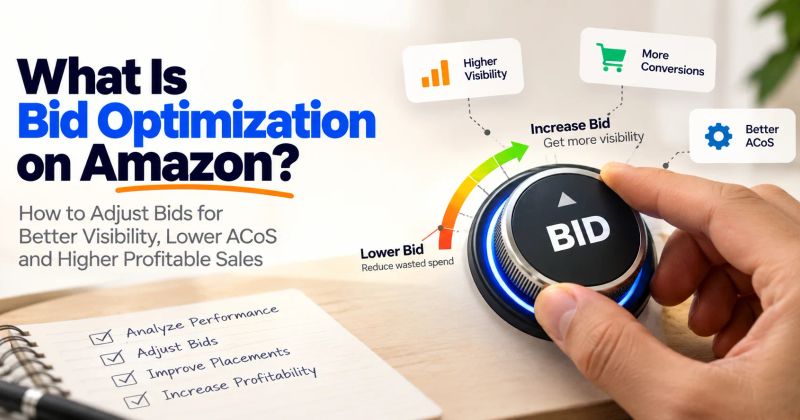
For bid-level decisions, see What Is Bid Optimization on Amazon?.
Key takeaways
- Scale campaigns with proven economics instead of increasing every campaign budget.
- A profitable campaign can become less efficient as spend increases.
- The key question is whether the next advertising dollar can produce acceptable incremental contribution.
- Budget, bids, targeting, placement, conversion, and inventory are different scaling constraints.
- Measure incremental sales and contribution, not revenue or average ACoS alone.
Frequently asked questions
Start with campaigns that have proven economics, identify the constraint limiting growth, change the appropriate lever in controlled steps, and monitor marginal performance.
About the author

Amazon Ads operators
Yogendra Kashyap is the Founder of SellerRoot and an Amazon Ads expert with 9+ years of experience helping brands grow through data-driven advertising. His expertise spans Amazon PPC, campaign optimization, search term analysis, and marketplace growth. Together with the SellerRoot team, he is building AI-powered tools for Amazon advertisers while sharing practical, experience-backed insights to help brands improve profitability and scale on Amazon.
Scale the opportunities, not the waste
SellerRoot helps Amazon advertisers identify where spend can be increased, where bids need attention, and where inefficient spend should be reduced using account-level performance data.