Hiring Amazon PPC management services is not simply about finding someone who can create campaigns and adjust bids.
Amazon Ads is becoming more automated and increasingly complex. Brands may manage multiple marketplaces, products, Sponsored Products, Sponsored Brands, Sponsored Display, DSP, placements, audiences, bidding strategies, and large volumes of search-term data.
The right provider should not simply make more campaign changes. It should help you make better advertising decisions.
1. Look for a Clear Optimization Process
Ask how the provider decides:
- Which campaigns need attention
- Which keywords or targets should be scaled
- When bids should increase or decrease
- Which search terms should become targets
- Which terms should become negatives
- Where budget should be reallocated
- When placement adjustments make sense
If the answer is simply "we optimize your campaigns every day," ask what that actually means.
You want a repeatable decision process, not just a promise of frequent account activity.
2. Look Beyond ACoS
ACoS is useful, but it should not be the only KPI.
A serious Amazon PPC management service should evaluate:
- Sales
- Ad spend
- ROAS
- ACoS
- TACoS
- Conversion rate
- CPC
- CTR
- Placement performance
- Product-level profitability
- Inventory position
The objective can differ by product and lifecycle.
A launch campaign may prioritize discovery and data collection. A mature product may require tighter efficiency. A strategic product may justify additional spend to defend visibility.
The provider should be able to explain why the target metrics make sense for your business.
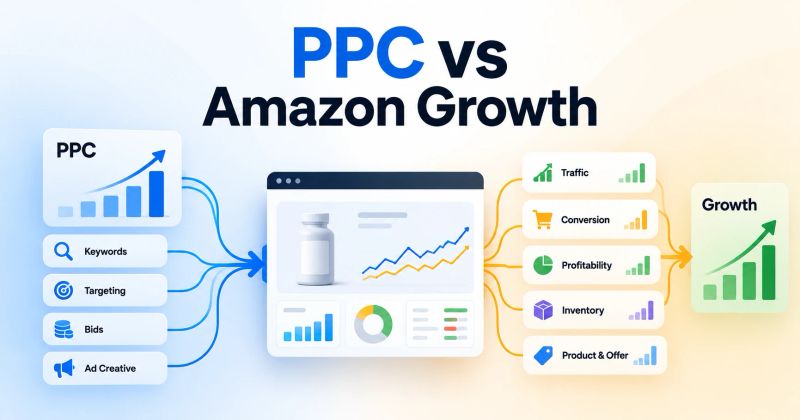
3. Make Sure They Understand the Product, Not Just PPC
Advertising cannot compensate indefinitely for a weak product detail page.
When advertising generates traffic but conversion remains weak, the problem may involve:
- Pricing
- Reviews
- Images
- A+ Content
- Product positioning
- Inventory
- Offer competitiveness
- Product-market fit
For example:
High impressions + low CTR
Could indicate a targeting, creative, relevance, or positioning problem.
High clicks + low conversion
Could indicate a listing, pricing, offer, review, or product problem.
Strong conversion + limited impressions
Could indicate an opportunity around bids, budget, targeting, or placement.
A good provider should know when the problem is not actually PPC.
4. Ask How They Handle Search-Term Data
Search-term analysis should have a repeatable workflow.
A provider should be able to explain how it:
- 1Finds converting search terms
- 2Identifies inefficient spend
- 3Discovers new keyword opportunities
- 4Moves useful terms into appropriate campaigns
- 5Adds negative keywords where justified
- 6Separates branded and non-branded intent where relevant
- 7Monitors changes over time
Do not accept "we check search terms regularly" as the complete answer.
Ask what thresholds, business context, and campaign structure influence the decision.
5. Understand Their Approach to Automation and AI
Automation is becoming a larger part of Amazon advertising.
That makes it important to understand what your provider actually contributes.
Ask:
- What do you automate?
- What decisions are still made by an operator?
- How do you review Amazon recommendations?
- How do you prevent automated changes from conflicting with business goals?
- How do you document significant account changes?
The value of an Amazon PPC provider should increasingly come from judgment, strategy, interpretation, and execution, not simply repetitive manual work.
6. Check Whether They Manage the Full Advertising Mix
Sponsored Products should not automatically be the entire strategy.
Depending on eligibility and objectives, a brand may also use:
- Sponsored Brands
- Sponsored Brands video
- Sponsored Brands collections
- Sponsored Display
- Display
- Video
- DSP
- Other Amazon Ads solutions
More ad types do not automatically mean better performance.
The provider should explain why a particular format is appropriate for your product, audience, marketplace, and objective.
7. Demand Transparent Reporting
A useful report should answer four questions:
What happened?
Why did it happen?
What did you change?
What should happen next?
Do not judge reporting by the number of charts.
A concise operating report with clear decisions can be more useful than a long report that only restates account metrics.
8. Understand Who Actually Manages Your Account
Before signing, ask:
- Who is responsible for my account?
- How many accounts do they manage?
- Who reviews their work?
- Who makes major budget decisions?
- Who handles launches?
- Who handles urgent issues?
- How frequently will we communicate?
You are hiring a management service, not just a company name.
9. Ask How They Connect PPC to Business Economics
A PPC manager should understand that the same ROAS can have very different implications for different products.
Consider:
- Product selling price
- COGS
- Amazon fees
- Fulfillment costs
- Discounts
- Returns
- Contribution margin
- Inventory
- Product lifecycle
A campaign can look efficient from an advertising perspective while still being unattractive economically.
Ask how the provider connects advertising decisions to your actual business economics.
10. Choose the Right Operating Model
There are three common ways to work with an Amazon PPC provider.
Fully Managed
The provider manages the advertising operation.
Best suited to: businesses that do not want to operate PPC internally.
Technology
Your team manages advertising while software provides analysis, intelligence, and optimization support.
Best suited to: sellers, brand owners, PPC operators, and agencies that want to retain control.
Technology + Managed Services
Your team and the provider's specialists work together using technology as the intelligence and operating layer.
Best suited to: brands that want both human expertise and technology.
What to Ask Before Hiring Amazon PPC Management Services
Before signing a contract, ask:
- 1Who will manage my account?
- 2What exactly is included?
- 3How do you evaluate search terms?
- 4How do you decide when to change bids?
- 5How do you allocate budgets?
- 6How do you evaluate placements?
- 7How do you handle negative targeting?
- 8Which KPIs do you report?
- 9How do you identify listing or conversion problems?
- 10What do you automate?
- 11What decisions require human review?
- 12Can I see a sample report?
- 13Can I see relevant case studies?
- 14What happens when advertising spend increases?
- 15What happens if we terminate the engagement?
SellerRoot
Model: Amazon Ads Intelligence, Optimization & Managed Services
SellerRoot combines Amazon Ads technology with hands-on managed services, allowing businesses to choose how much of their advertising operation they want to handle themselves.
Use SellerRoot yourself
For sellers, brand owners, PPC specialists, and agencies that want to manage advertising themselves, SellerRoot provides the technology to analyze account performance, identify optimization opportunities, understand what is changing, and prioritize what needs attention.
The platform helps turn Amazon Ads data into structured, actionable insights across:
- Campaigns
- Targets
- Search terms
- Bids
- Budgets
- Placements
- Performance trends
- Account-level opportunities
You remain in control of the advertising decisions and execution.
Let SellerRoot manage it for you
For businesses that do not want to manage Amazon advertising themselves, SellerRoot also provides managed Amazon advertising services.
Our team can take responsibility for advertising analysis, optimization, campaign management, reporting, and ongoing performance management.
Technology + managed services
Your team and SellerRoot's specialists can work together, using the platform as the operating and intelligence layer.
This gives businesses three options:
Technology only
You manage your Amazon Ads. SellerRoot provides the intelligence and optimization platform.
Managed services
SellerRoot's team manages your Amazon advertising for you.
Technology + managed services
Your team and SellerRoot's specialists work together using both technology and human expertise.
Final Takeaway
The right Amazon PPC management service should do more than change bids.
It should understand advertising data, product economics, customer intent, marketplace conditions, automation, and the business objective behind the account.
As Amazon Ads becomes increasingly AI-assisted, the question is no longer simply:
"Can this provider manage my campaigns?"
A better question is:
"Can this provider consistently identify what matters, explain why it matters, and execute the right action?"
That is the standard Amazon brands should use when evaluating PPC management services.
Key takeaways
- A strong Amazon PPC provider should have a clear process for deciding what to optimize and why.
- ACoS and ROAS alone do not show whether advertising is contributing to profitable business growth.
- Search-term analysis, budget allocation, bidding, placements, and conversion issues should be evaluated together.
- As Amazon Ads becomes more automated, providers should add judgment, strategy, interpretation, and execution rather than only repetitive manual work.
- Brands should choose between managed services, technology, or a combination based on the capabilities they already have.
Frequently asked questions
Look for a clear optimization process, relevant Amazon experience, transparent reporting, search-term analysis, bidding and budget methodology, understanding of product economics, and clear account ownership.
About the author

Amazon Ads operators
Yogendra Kashyap is the Founder of SellerRoot and an Amazon Ads expert with 9+ years of experience helping brands grow through data-driven advertising. His expertise spans Amazon PPC, campaign optimization, search term analysis, and marketplace growth. Together with the SellerRoot team, he is building AI-powered tools for Amazon advertisers while sharing practical, experience-backed insights to help brands improve profitability and scale on Amazon.
Make Amazon PPC Management Easier
SellerRoot helps Amazon businesses analyze, optimize, and manage advertising through technology, managed services, or a combination of both.