Amazon PPC optimization is not about changing more bids, adding more keywords, or checking the advertising console every few hours.
It is about identifying which part of the advertising system is limiting performance and making the change most likely to improve the business.
A campaign with high ACoS can have very different causes:
- The search traffic is irrelevant.
- The traffic is relevant but CPC is too high.
- The traffic is good but the product page does not convert.
- The campaign is budget constrained.
- A placement is producing poor economics.
- The product itself has weak economics.
- There is not enough data to make a reliable decision.
Those situations require different actions.
The best Amazon PPC optimization tips therefore start with diagnosis, not with a bid adjustment.
What Amazon PPC Optimization Actually Means
Amazon PPC optimization means improving the relationship between advertising spend, qualified traffic, conversion, sales, and contribution.
That can mean:
- More sales from the same advertising budget
- Less irrelevant or unproductive spend
- Better conversion from qualified traffic
- Better budget allocation
- Better control over proven search demand
- More efficient customer acquisition
- More profitable incremental sales
It does not always mean lowering ACoS.
A launch campaign may deliberately accept higher ACoS while building demand. A branded campaign may have very low ACoS but limited incremental value. A non-branded campaign may have higher ACoS but be responsible for acquiring new customers.
The campaign objective and product economics determine what good performance looks like.
1. Start With Search Terms, Not Bids
The search term report is one of the most useful places to begin an optimization review.
The first question is not:
Which bids should I lower?
It is:
What searches are actually consuming the budget?
Separate search terms into four groups.
Proven demand
The query is relevant and generates sales at acceptable economics.
Possible action:
- Promote it into tighter targeting.
- Test exact match where appropriate.
- Give it enough budget to continue capturing demand.
Relevant but expensive
The query clearly matches the product, but CPC, conversion, or both make the economics weak.
Possible action:
- Review CPC.
- Review conversion rate.
- Check placement.
- Check the product detail page.
- Reduce the bid if the economics support doing so.
Irrelevant demand
The shopper is searching for something you do not actually want to advertise against.
Possible action:
- Add a negative keyword where appropriate.
- Add negative product targeting where appropriate.
- Tighten the targeting structure.
Insufficient evidence
There are not enough clicks, sales, or meaningful observations to justify a strong conclusion.
Possible action:
Wait.
This fourth category is often missing from simplistic PPC advice.
2. Promote Proven Search Terms With Evidence
Discovery should create control.
When a search term repeatedly produces useful sales, consider moving that learning into a campaign where you can manage the target, bid, budget, and reporting more deliberately.
A practical operating path is:
Discover → Validate → Control → Scale
But do not promote every search term that gets one order.
The evidence should be considered against:
- Spend
- Clicks
- Orders
- Conversion rate
- CPC
- ACoS
- Product margin
- Campaign objective
A single sale from a high-AOV product can mean something very different from a single sale on a low-margin commodity product.
The goal is not to create more exact-match keywords.
The goal is to create more useful control where the economics justify it.
3. Do Not Lower Every Bid Because ACoS Is High
A high ACoS is a symptom, not a diagnosis.
Before reducing a bid, ask:
- 1Is the traffic relevant?
- 2Is the target converting?
- 3Is CPC unusually high?
- 4Is the product competitive?
- 5Is the placement responsible for the high cost?
- 6Is this campaign supposed to prioritize efficiency or growth?
- 7Is the product economics strong enough to support the current acquisition cost?
Consider two targets.
Target A
- 20 clicks
- 2 orders
- relevant search
- high CPC
Target B
- 20 clicks
- 0 orders
- weak relevance
- poor search-term quality
They may both show poor ACoS.
They should not receive the same optimization.
Target A may need an economic bid decision.
Target B may need traffic control.
4. Separate Irrelevant Traffic From Expensive Traffic
This distinction is one of the most important rules in Amazon PPC management.
Irrelevant traffic means the shopper query or product target is commercially wrong.
Expensive traffic means the shopper may be relevant, but acquiring that shopper costs too much.
For irrelevant traffic, consider:
- Negative keywords
- Negative product targets
- Match-type changes
- Targeting refinement
For expensive but relevant traffic, consider:
- Bid reduction
- Placement adjustment
- Conversion improvement
- Campaign restructuring
- Budget reallocation
Do not use negative keywords simply because a target has not produced a sale.
A relevant keyword with 10 clicks and no order may need more evidence.
A clearly irrelevant search term consuming $150 deserves a different response.
5. Fix Conversion Before Buying More Traffic
If clicks are coming in but orders are not, increasing the bid can simply buy more traffic into the same conversion problem.
Check the retail side:
- Main image
- Product title
- Price
- Reviews and rating
- Bullet points
- A+ Content
- Variations
- Promotions
- Inventory
- Featured Offer status
- Shipping promise
Example: a home product
Suppose a product receives:
- Strong impressions
- Strong CTR
- Good search relevance
- Acceptable CPC
- Weak conversion
Reducing the bid may lower spend, but it does not solve the underlying retail problem.
If competitors are $10 cheaper, have stronger review counts, and present better main images, PPC optimization alone will not fix the conversion rate.
A PPC manager needs to know when to stop optimizing the ad and start investigating the product detail page.
6. Allocate Budget Based on the Next Dollar
Historical sales do not automatically tell you where the next advertising dollar should go.
Suppose:
Campaign A
- $500 spend
- $2,000 ad sales
- 25% ACoS
- budget constrained
Campaign B
- $100 spend
- $600 ad sales
- 16.7% ACoS
- plenty of unused budget
You cannot decide the next $100 using ACoS alone.
Ask:
Where is the next dollar most likely to produce useful incremental sales at acceptable economics?
Consider:
- Conversion rate
- CPC
- ACoS
- ROAS
- Impression opportunity
- Budget constraints
- Campaign objective
- Product margin
- Recent performance
- Marginal return
A campaign with lower historical ACoS is not automatically the best destination for additional budget.
7. Use Placement Data Instead of Assuming Top-of-Search Is Better
Placement performance can reveal very different economics inside the same campaign.
For example:
- Top-of-search may have strong conversion but high CPC.
- Product pages may have lower CPC but weak conversion.
- Rest-of-search may produce lower-volume but efficient sales.
Do not optimize placement from a generic rule such as:
“Increase top-of-search because it gets the most visibility.”
Optimize it from the economics of the traffic.
If a placement produces incremental sales at acceptable economics, it has a stronger case for additional investment.
8. Keep Automatic Campaigns as Discovery Engines
Automatic campaigns can generate useful information about customer search behavior and product targeting.
The mistake is treating them in one of two ways:
Mistake 1: Leave them untouched indefinitely.
Mistake 2: Shut them down as soon as manual campaigns are created.
A better operating model is:
Automatic = discovery
Manual = control
The exact balance depends on the product, category, maturity, search volume, and campaign objective.
For a new product, discovery can be particularly valuable because the account has less historical evidence.
For a mature product, proven search terms may justify much tighter control.
9. Do Not Over-Segment the Account
More campaigns do not automatically mean more control.
Every campaign creates:
- Another budget
- Another target set
- Another reporting layer
- Another optimization decision
Create separation when it changes what you can decide.
Useful reasons include:
- Different campaign objectives
- Different products
- Different budget requirements
- Different targeting strategies
- Brand vs non-brand intent
- Discovery vs control
- Different profitability expectations
If two campaigns require the same bid logic, budget logic, targeting logic, and decision process, splitting them may simply increase management overhead.
For the underlying structure, see Amazon PPC campaign structure.
10. Use Match Types as a Control System, Not a Religion
Broad, phrase, and exact match can serve different roles, but there is no universal rule that says exact must always have the highest bid or broad must always have the lowest.
A common starting structure is:
- Broad: discovery and query expansion
- Phrase: controlled expansion around proven themes
- Exact: tighter control around proven search behavior
Then let the data override the theory.
If a broad target generates strong relevant traffic at acceptable economics, do not reduce it simply because it is broad.
If an exact target has poor economics, exact match does not make it good.
Match type controls traffic. Economics determines whether that traffic deserves investment.
11. Watch ASIN-Level Performance
Campaign-level averages can hide product-level problems.
This becomes especially important for accounts advertising multiple products.
Consider a campaign with five ASINs:
- ASIN A: 18% ACoS
- ASIN B: 22%
- ASIN C: 31%
- ASIN D: 47%
- ASIN E: 9%
A campaign-level ACoS may look acceptable while ASIN D is consuming a disproportionate amount of budget.
Review:
- Spend by ASIN
- Sales by ASIN
- Orders
- Conversion rate
- ACoS
- ROAS
- Inventory position
- Product margin
If the products have materially different economics, they may deserve different campaign structures.
12. Judge Branded and Non-Branded Campaigns Differently
A branded campaign and a non-branded campaign can both show 15% ACoS while doing very different jobs.
Branded
The shopper may already know:
- Brand name
- Product name
- Brand + category
The campaign may be serving a defensive or demand-capture role.
Non-branded
The shopper may be discovering the brand for the first time.
The campaign may have a stronger customer-acquisition role and a higher acceptable acquisition cost.
Therefore:
Do not use one ACoS target across every campaign simply because the dashboard makes it convenient.
Consider:
- Incremental sales
- New customer objectives
- Organic brand demand
- Competition
- Campaign role
- Product margin
This is especially important for established brands where branded PPC can look extremely efficient while adding less incremental demand than non-branded advertising.
13. Optimize ACoS and ROAS in Context
ACoS and ROAS are operating metrics, not complete profitability metrics.
A 25% ACoS produces a 4.0 ROAS.
But that does not tell you whether the sale is profitable.
For a product with:
- High COGS
- High FBA fees
- High return rates
- Heavy couponing
25% ACoS may be difficult to support.
For a product with:
- Strong contribution margin
- High AOV
- Repeat-purchase potential
- Low return rates
the economics can be very different.
Look at:
- Contribution margin
- TACoS
- Product costs
- Amazon fees
- Fulfillment
- Returns
- Discounts
- Organic sales
- Inventory constraints
For more detail on the relationship between ACoS and ROAS, see how to lower ACoS on Amazon.
14. Do Not Optimize the Advertising Dashboard in Isolation
Amazon PPC performance is affected by what happens outside the campaign manager.
Before taking credit for an improvement, check:
- Price changes
- Coupons
- Promotions
- Inventory availability
- Featured Offer status
- Listing changes
- Reviews
- Competitor pricing
- Seasonality
- Product launches
- External traffic
Example: supplement category
If conversion rate improves from 10% to 14% immediately after a major listing rewrite and coupon launch, attributing the entire improvement to a bid change would be weak analysis.
The advertising data changed.
But the retail environment changed too.
That is why account diagnosis needs context.
15. Know When Not to Make a Change
This is one of the most valuable optimization skills.
Do not force a decision when the evidence is weak.
Examples:
Low-volume keyword
5 clicks, 0 orders.
There may simply be insufficient evidence.
Recent bid change
A bid was changed yesterday.
Do not immediately make another change because today's ACoS moved.
Promotion period
A coupon or deal is running.
Performance may not represent normal economics.
Inventory problem
The product was unavailable or the Featured Offer was lost.
PPC changes may not solve the underlying issue.
Seasonal category
Demand has changed.
Historical benchmarks may no longer be directly comparable.
The best optimization decision can sometimes be:
No change yet. Collect better evidence.
16. Make Fewer Changes, But Make Better Changes
Changing bids, budgets, negatives, campaign structure, placements, and listing elements at the same time creates a measurement problem.
Performance changes.
You do not know which change caused it.
A better operating process is:
Observe → Diagnose → Change → Measure → Decide
For major changes, isolate the variable where practical.
For routine account management, prioritize decisions that can materially affect spend or sales.
The goal is not to document every click.
The goal is to make the decisions that matter.
17. Treat Amazon Recommendations as Inputs, Not Instructions
Amazon's automated recommendations can surface useful opportunities.
But an operator still needs to ask:
- Does this fit the product economics?
- Does this campaign have the right objective?
- What happens to total account spend?
- Will the change increase useful sales or simply increase traffic?
- Is there enough evidence?
- Does this recommendation conflict with the campaign's role?
Automation can reduce analysis time.
It should not remove commercial judgment.
How Amazon PPC Optimization Changes by Category
The mechanics of PPC are similar across categories.
The economics are not.
Beauty and Personal Care
Watch:
- Review strength
- Image and creative quality
- Variant structure
- Competitive pricing
- Repeat purchase
- Branded demand
A bid problem can actually be a conversion or brand-demand problem.
Supplements
Watch:
- Contribution margin
- Coupons
- Reviews
- Subscribe & Save
- Compliance-sensitive claims
- Repeat purchase
- Product economics
A low ACoS campaign is not automatically valuable if the product economics are weak.
Home and Kitchen
Watch:
- Main image
- Price
- Variations
- Size and shipping economics
- Seasonal demand
- Competitor assortment
Conversion changes can materially alter the correct PPC decision.
Apparel
Watch:
- Variation-level performance
- Size availability
- Return rate
- Price
- Reviews
- Seasonality
Campaign averages can hide a strong product variation and a weak one inside the same advertised product group.
Books
Watch:
- Royalty economics
- Price
- Review volume
- Format
- Series relationships
- Author/brand demand
A book campaign should not necessarily use the same economics as a consumable or high-AOV product.
The principle is consistent:
PPC optimization follows product economics.
Sponsored Products, Sponsored Brands, and Sponsored Display Need Different Optimization
Do not treat every Amazon ad type as the same system.
Sponsored Products
The main optimization surfaces include:
- Search terms
- Keyword targets
- Product targets
- Bids
- Placements
- Budgets
- Advertised ASINs
Sponsored Brands
Look more closely at:
- Brand vs non-brand demand
- Creative
- Landing destination
- Product selection
- New-customer objectives
- Branded search behavior
Sponsored Display
The analysis can shift toward:
- Audience
- Product targeting
- Placement
- Retargeting role
- Funnel position
- Incremental economics
The optimization question should therefore start with:
What job is this ad type performing?
Then optimize the levers that affect that job.
A Practical Amazon PPC Optimization Workflow
Step 1: Check economics
Know:
- Break-even ACoS
- Target ACoS
- Contribution margin
- Campaign objective
Step 2: Find the largest opportunity
Look for:
- Wasted spend
- High CPC
- Poor conversion
- Budget constraints
- Weak targets
- Product-level problems
Step 3: Analyze search terms
Separate:
- Proven
- Relevant but expensive
- Irrelevant
- Insufficient data
Step 4: Control traffic
Use:
- Negative keywords
- Negative product targets
- Match types
- Campaign separation
Step 5: Adjust bids
Change bids after understanding traffic quality and economics.
Step 6: Reallocate budgets
Move money toward stronger opportunities rather than simply funding the campaigns with the highest historical sales.
Step 7: Check the retail side
If clicks are coming but orders are not, investigate the product.
Step 8: Measure the result
Compare performance against an appropriate baseline while accounting for:
- Promotions
- Price
- Inventory
- Seasonality
- Campaign changes
- Attribution windows
Amazon PPC Optimization Tips Checklist
Before making a major change, ask:
- Is the traffic relevant?
- Is the target converting?
- Is CPC reasonable for the product economics?
- Is the product page converting?
- Is the campaign budget constrained?
- Is the campaign discovery or control?
- Are negative targets actually required?
- Is placement performance materially different?
- Is the ASIN economically viable?
- Is branded and non-branded performance being judged appropriately?
- Is there enough data?
- What is the expected effect of this change?
- How will I know whether it worked?
If the last two questions cannot be answered, the optimization may be premature.
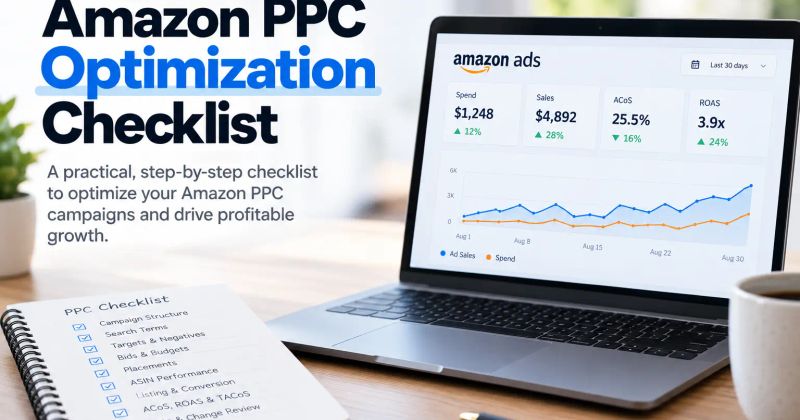
For a structured account review, use the Amazon PPC optimization checklist.
Final Takeaway
The Amazon PPC optimization tips that actually work are not tricks.
They are decisions based on:
Traffic quality → Conversion → Economics → Allocation → Measurement
Find the search behavior.
Understand the product economics.
Separate irrelevant traffic from expensive traffic.
Control proven demand.
Fix retail problems when PPC is not the constraint.
Allocate the next dollar where the marginal opportunity is strongest.
Make fewer changes.
Measure what actually changed.
The objective is not to make the Amazon Ads dashboard look better.
The objective is to make the advertising dollar work harder.
Key takeaways
- Diagnose the source of poor performance before changing bids, budgets, or targeting.
- Separate irrelevant traffic from relevant traffic that is simply too expensive.
- Promote proven search terms when the data supports moving from discovery to tighter control.
- Allocate the next advertising dollar based on marginal opportunity, not historical sales alone.
- Treat the product detail page, pricing, inventory, and Featured Offer as part of the PPC system.
- Use fewer, higher-confidence changes and measure their effect against the right business baseline.
Frequently asked questions
Diagnose the problem before changing the campaign. Determine whether the issue is traffic quality, conversion, bidding, budget, placement, product economics, or insufficient data.
About the author

Amazon Ads operators
Yogendra Kashyap is the Founder of SellerRoot and an Amazon Ads expert with 9+ years of experience helping brands grow through data-driven advertising. His expertise spans Amazon PPC, campaign optimization, search term analysis, and marketplace growth. Together with the SellerRoot team, he is building AI-powered tools for Amazon advertisers while sharing practical, experience-backed insights to help brands improve profitability and scale on Amazon.
Find more opportunities in your Amazon PPC account
SellerRoot helps Amazon brands surface and prioritize optimization opportunities across search terms, targets, campaigns, bids, and budgets.