Amazon PPC optimization is not about lowering bids until ACoS looks good. It is about finding where advertising spend is producing enough business value, where it is being wasted, and what change is most likely to improve the account.
A strong optimization process looks at search terms, targets, bids, budgets, placements, campaign structure, conversion, and profitability together. The goal is not to make the account look tidy. The goal is to make better advertising decisions from the data Amazon gives you.
What Amazon PPC Optimization Actually Means
Amazon PPC optimization means making deliberate changes to campaigns based on performance data and the commercial objective of the account.
An account can have a low ACoS and still be poorly optimized. It may be leaving sales on the table because profitable campaigns are underfunded. It may also have campaigns with attractive ROAS that are too small to matter.
Likewise, a campaign with a high ACoS is not automatically a problem. A launch campaign, discovery campaign, or strategic branded campaign can have a different job from a mature profitability campaign.
Before changing anything, define what the campaign is supposed to accomplish.
Typical objectives include:
- Profitable sales
- Sales growth
- Keyword discovery
- Product discovery
- Brand defense
- New-to-brand customer acquisition
- Supporting an important product
- Clearing inventory
- Testing new targeting
Optimization starts when the objective and the numbers are considered together.
Start With an Amazon PPC Audit
Do not begin by changing bids one campaign at a time. Start by identifying where the account has the largest opportunities.
A useful audit should answer five questions:
- 1Where is the account spending money?
- 2Where is it generating sales?
- 3Which targets are consuming spend without enough return?
- 4Which targets are performing well but are constrained by bids or budgets?
- 5Which structural problems make optimization harder?
Look across:
- Campaign performance
- Search terms
- Keywords
- Product targets
- Bids
- Budgets
- Placements
- Match types
- Campaign types
- Brand versus non-brand traffic
- Product conversion
- Recent changes
The purpose of the audit is prioritization.
If a campaign spends ₹50,000 per month, a small bid adjustment may matter more than a campaign spending ₹500. Start where the economic impact is largest.
1. Find and Reduce Wasted Ad Spend
Wasted spend is usually one of the clearest places to find an immediate optimization opportunity.
Wasted spend does not simply mean every click that did not produce an order. Advertising needs enough traffic to generate data.
Instead, look for patterns such as:
- Search terms with substantial spend and no sales
- Targets spending significantly above the account's acceptable acquisition cost
- Irrelevant search queries
- Product targets that repeatedly consume budget without useful results
- Traffic that converts poorly despite enough data
- Duplicate or overlapping targeting that creates unnecessary complexity
The exact threshold should depend on the product's economics and conversion rate.
For example, if a product sells for ₹2,000 and the business can support a ₹500 advertising cost per order, a target that has already spent well beyond that level without a sale deserves investigation.
The important point is that the decision should be based on spend relative to expected economics, not an arbitrary universal number.
2. Optimize Search Terms
Search-term data tells you what shoppers actually typed, which can be more useful than looking only at the keyword you originally targeted.
Suppose you target the keyword:
running shoes
Amazon may generate traffic from searches such as:
- men's running shoes
- running shoes for women
- lightweight running shoes
- running shoes for flat feet
- cheap running shoes
These searches can behave very differently.
A search term that consistently generates profitable sales may deserve more control. Depending on the campaign structure, you may move it into a more controlled campaign or adjust the existing targeting around it.
A search term that repeatedly spends without producing acceptable results may need a negative keyword or negative product decision.
Do not promote or negate terms based on a single click or isolated order. Look at enough data to understand the pattern.
3. Control Match Types
Broad, phrase, and exact match should serve different levels of control rather than being treated as interchangeable traffic sources.
Broad Match
Broad can help discover variations and new search behavior.
It can also generate a wide range of queries, which makes search-term review important.
Phrase Match
Phrase gives you more control while still allowing variation around the keyword.
It can be useful when you understand the search theme but do not want to restrict traffic as tightly as exact match.
Exact Match
Exact is generally used when you want tighter control over a proven keyword or search term.
The important point is not to force every keyword into exact match. Build control where the data justifies it.
4. Optimize Bids Based on Economics
A bid should reflect what the traffic is worth to the business, not simply whether the current ACoS looks high or low.
Consider:
- Conversion rate
- Selling price
- Contribution margin
- Target ACoS
- Target CPA
- Competition
- Placement
- Keyword intent
- Historical performance
- Campaign objective
A simple example:
A target generates sales at a conversion rate that supports your desired acquisition cost. If the target is profitable but receiving very little traffic, reducing the bid because the ACoS is slightly above the account average may be the wrong decision.
On the other hand, if a target has accumulated meaningful spend and consistently produces poor economics, maintaining an aggressive bid simply because it receives clicks is difficult to justify.
Bid optimization is therefore a balance between traffic volume and traffic economics.
5. Manage Budgets Where They Matter
Budget optimization is about allocating available spend toward campaigns that can use it productively.
Look for two opposite situations.
Campaigns That Run Out of Budget
A profitable campaign repeatedly hitting its daily budget may be limiting sales.
Check:
- ACoS
- ROAS
- Conversion rate
- Sales volume
- Margins
- Campaign objective
If the economics support additional spend, increasing the budget may be more useful than optimizing bids downward.
Campaigns With Excess Budget
A campaign that rarely uses its budget does not automatically need a higher budget.
The issue may instead be:
- Low traffic
- Low bids
- Limited search volume
- Weak targeting
- Poor product relevance
Budget should follow opportunity.
6. Use Negative Keywords and Negative Product Targets
Negative targeting is one of the main controls for preventing repeated spend on traffic that does not fit the campaign.
Common use cases include:
- Irrelevant search terms
- Poor-performing queries
- Unwanted brand traffic
- Overlap between campaigns
- Product targets that do not fit the strategy
Negatives should be applied carefully.
For example, adding a broad negative based on a single poor search term can remove potentially useful traffic. Confirm the pattern and understand how the negative will affect related searches before applying it.
7. Look at Placement Performance
Amazon advertising performance can differ significantly by placement, so campaign-level averages can hide useful information.
Review performance across available placement categories and compare:
- Spend
- Sales
- Orders
- Conversion rate
- ACoS
- ROAS
If a placement consistently produces stronger economics, it may justify a more aggressive approach.
If another placement consumes significant spend with weak conversion, investigate whether the campaign structure or bid strategy should change.
Do not optimize placement in isolation. Consider the campaign's objective and the amount of data available.
8. Optimize Campaign Structure
Campaign structure should make performance easier to understand and control.
A practical structure usually separates important differences in:
- Match type
- Targeting intent
- Brand versus non-brand
- Product groups
- Campaign objective
- Discovery versus control
However, more campaigns do not automatically create more control.
If a seller creates dozens of campaigns with tiny budgets and insufficient traffic, the account can become harder to optimize because each campaign produces too little data.
A useful rule is:
Build campaigns around decisions, not around complexity.
The structure should help you answer questions such as:
- Which targets are profitable?
- Which search terms need control?
- Where should more budget go?
- Which traffic is discovery traffic?
- Which campaigns should be scaled?
- Which campaigns need to be contained?
9. Separate Discovery From Control
Discovery and control are different jobs, and combining them can make optimization harder.
Discovery campaigns help you find:
- New search terms
- New keyword variations
- New product targets
- New customer demand
Control campaigns give you tighter management over proven opportunities.
A common optimization process is:
Discover → Evaluate → Promote or Control → Scale
For example, a search term discovered through an automatic or broad campaign may generate consistent sales. Once the data supports it, you can give that search term more deliberate control through your campaign structure.
At the same time, the original discovery campaign can continue doing its discovery job.
10. Optimize Based on the Product's Economics
ACoS is useful, but it should not be the only number driving optimization decisions.
Consider the relationship between:
- Selling price
- Product cost
- Amazon fees
- Fulfillment cost
- Discounts
- Contribution margin
- Advertising cost
- Target profit
A 20% ACoS is not automatically good.
If margins are strong, the business may support a higher ACoS while growing aggressively.
If margins are thin, even a relatively low ACoS may not leave enough contribution after advertising and other costs.
This is why optimization should ultimately connect advertising performance to business economics.
11. Diagnose High ACoS Before Changing Anything
High ACoS is a symptom, not a diagnosis.
Several different problems can produce the same high ACoS.
High CPC
Traffic may simply be too expensive.
Investigate:
- Bids
- Competition
- Placement
- Targeting
Low Conversion Rate
The problem may be downstream from the ad.
Investigate:
- Listing relevance
- Main image
- Title
- Reviews
- Price
- Offer
- A+ Content
- Competitive positioning
Poor Search-Term Relevance
The campaign may be buying traffic that does not closely match the product.
Investigate:
- Search-term reports
- Match types
- Negative keywords
- Targeting
Low Order Value
A product with a low selling price may struggle to support expensive clicks.
The answer may involve:
- Bid economics
- Product pricing
- Bundling
- Cross-selling
- Conversion improvements
Do not use the same optimization action for every high-ACoS campaign.
12. Diagnose Low ACoS Too
A very low ACoS can also deserve investigation.
For example, a campaign may have excellent ACoS because it receives very little traffic.
Ask:
- Is the campaign generating enough sales?
- Is the budget limiting growth?
- Are bids too conservative?
- Is search volume being captured?
- Is the campaign focused only on branded traffic?
- Is there room to expand profitable reach?
Optimization is not simply a race toward the lowest possible ACoS.
13. Review Campaigns at the Right Cadence
Optimization works better when changes are made on a consistent review cadence instead of reacting to every daily fluctuation.
A useful process can include:
Daily
Check for obvious operational problems:
- Campaigns unexpectedly paused
- Budget exhaustion
- Major spend anomalies
- Sudden performance changes
Weekly
Review:
- Search terms
- Targets
- Bids
- Budgets
- ACoS
- ROAS
- Conversion rate
- Placement performance
Monthly
Review the broader account:
- Campaign structure
- Product economics
- Budget allocation
- Growth opportunities
- Waste trends
- Strategic objectives
The exact cadence should change with spend and account size. A high-spend account needs more frequent monitoring than a small account.
14. Prioritize Optimization Opportunities
Not every optimization opportunity deserves immediate action.
A useful prioritization approach is to consider:
- 1Financial impact
- 2Confidence in the data
- 3Ease of implementation
- 4Strategic importance
For example:
| Opportunity | Potential impact | Confidence | Action |
|---|---|---|---|
| High spend, no sales | High | High | Investigate quickly |
| Profitable campaign hitting budget | High | High | Review budget |
| One poor click | Very low | Low | Usually wait |
| Strong search term with repeated sales | High | High | Consider more control |
| Low ACoS with very low volume | Medium | Medium | Investigate scale potential |
This prevents the account manager from spending time on low-impact changes while larger problems remain untouched.
15. Do Not Change Too Many Variables at Once
If you change bids, budgets, targeting, negatives, and campaign structure simultaneously, it becomes difficult to know what caused the result.
This is especially important when testing a new strategy.
Make meaningful changes, record them, and evaluate the resulting performance.
A simple change log can contain:
- Date
- Campaign
- Target
- Previous setting
- New setting
- Reason
- Expected outcome
- Result
Over time, this creates an account history that makes future optimization more informed.
A Practical Amazon PPC Optimization Workflow
A repeatable workflow is more valuable than a long list of isolated tactics.
Use this sequence:
Step 1: Define the objective
Decide whether the campaign is designed for profitability, growth, discovery, brand defense, or another business objective.
Step 2: Identify the largest problems
Find meaningful waste, budget constraints, weak targets, poor search terms, and structural issues.
Step 3: Check the data quality
Make sure there is enough spend, clicks, orders, and time to support the decision.
Step 4: Diagnose the cause
Ask whether the issue is related to:
- Bid
- Budget
- Targeting
- Search term
- Placement
- Conversion
- Product economics
- Campaign structure
Step 5: Make the smallest useful change
Do not rebuild the account when a focused change can solve the problem.
Step 6: Record the change
Keep a change log so performance can be evaluated against the action taken.
Step 7: Reassess
Measure the result over an appropriate period before making another major change.
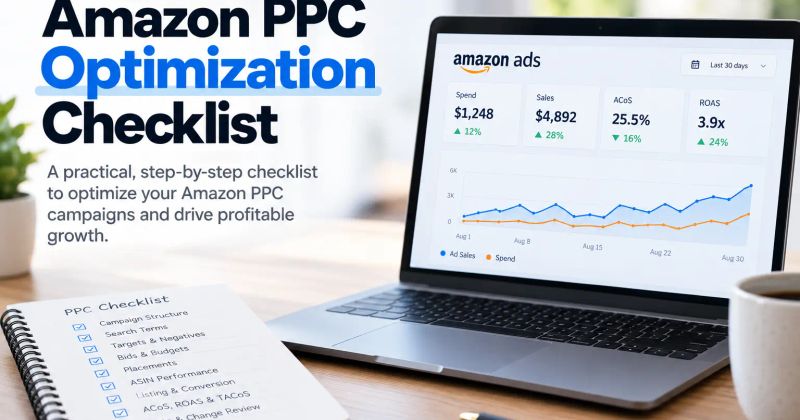
Amazon PPC Optimization Checklist
Use this checklist during a regular account review.
- Campaign objectives are clearly defined
- High-spend, low-return targets have been identified
- Search-term performance has been reviewed
- Relevant search terms have appropriate control
- Negative keywords and product targets are reviewed
- Bids are aligned with product economics
- Budgets are allocated according to opportunity
- Placement performance has been checked
- Discovery and control campaigns have clear roles
- Campaign structure supports useful decisions
- Conversion problems are separated from advertising problems
- High and low ACoS campaigns have both been investigated
- Major changes are recorded
- Optimization priorities are based on financial impact
Common Amazon PPC Optimization Mistakes
Most optimization mistakes come from treating metrics as instructions instead of signals.
Lowering every high-ACoS bid
High ACoS may be caused by conversion or relevance, not just bidding.
Pausing targets too quickly
A target with limited data may need more evidence before a final decision.
Increasing every profitable campaign's budget
A profitable campaign can still have limited demand or weak incremental opportunity.
Building too many campaigns
More campaigns can create more complexity without creating more useful control.
Optimizing only for ACoS
ACoS does not show the full economic or strategic value of a campaign.
Making changes without recording them
Without a change history, it becomes difficult to connect actions to outcomes.
When Should You Optimize Amazon PPC Campaigns?
Optimization should be continuous, but continuous does not mean constantly changing settings.
The account should be monitored regularly, while actual changes should be driven by meaningful evidence.
The frequency depends on:
- Monthly ad spend
- Number of campaigns
- Conversion volume
- Product count
- Marketplace
- Seasonality
- Business objective
- Account maturity
A small account may need a simpler weekly optimization process.
A large account with significant daily spend may require much more frequent monitoring and prioritization.
Final Takeaway
Good Amazon PPC optimization is the process of turning advertising data into better decisions.
The core levers are straightforward:
- Search terms
- Keywords
- Product targets
- Bids
- Budgets
- Negatives
- Placements
- Campaign structure
- Conversion
- Product economics
The difficult part is knowing which lever to change, when to change it, and how much the change should matter.
Do not optimize an Amazon PPC account simply to produce a better-looking dashboard.
Optimize it to reduce waste, protect profitable traffic, find new opportunities, and allocate advertising spend where it can create the most useful business result.
SellerRoot is built around this problem: helping Amazon sellers and PPC teams identify and prioritize optimization opportunities across campaigns, targets, search terms, bids, and budgets.
Explore SellerRoot's Amazon PPC optimization platform
Key takeaways
- Start optimization with the account data, not with bid changes.
- Separate profitable search terms from terms that consume spend without producing enough sales.
- Use bids, budgets, negatives, targeting, and campaign structure together.
- Prioritize changes that can materially improve sales, profitability, or wasted spend.
- Review performance on a regular cadence instead of making random daily changes.
Frequently asked questions
Review performance regularly, but do not change every campaign every day. The right cadence depends on spend, conversion volume, campaign maturity, and how quickly the account generates enough data to support a decision.
About the author

Amazon Ads operators
Yogendra Kashyap is the Founder of SellerRoot and an Amazon Ads expert with 9+ years of experience helping brands grow through data-driven advertising. His expertise spans Amazon PPC, campaign optimization, search term analysis, and marketplace growth. Together with the SellerRoot team, he is building AI-powered tools for Amazon advertisers while sharing practical, experience-backed insights to help brands improve profitability and scale on Amazon.
Want to optimize your Amazon PPC campaigns more systematically?
SellerRoot helps Amazon sellers identify and prioritize optimization opportunities across campaigns, targets, search terms, bids, and budgets.