If you ask ten Amazon PPC managers what a "good ACoS" is, you will probably hear numbers like 20%, 25%, or 30%.
Those numbers are easy to remember.
They are also poor targets when they are disconnected from your product economics.
There is no universal good ACoS on Amazon. Amazon's own guidance says the right ACoS depends on factors such as the business and campaign context, and recommends considering ACoS alongside other performance metrics.
The more useful question is:
What ACoS can this product and campaign support while still achieving its objective?
That answer starts with break-even ACoS.
What Does ACoS Mean?
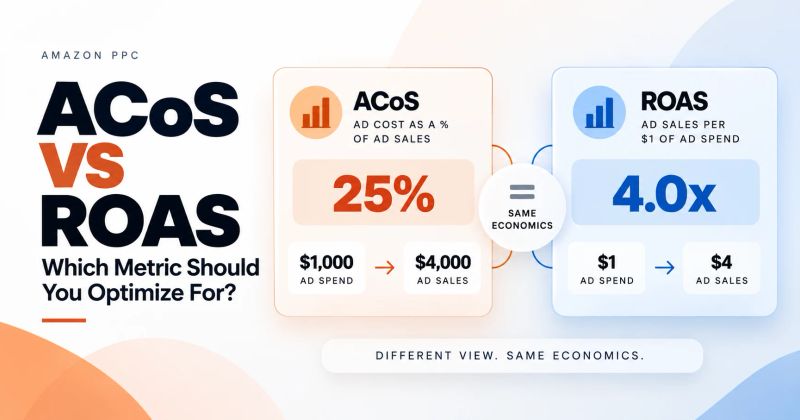
ACoS stands for Advertising Cost of Sales.
The formula is:
ACoS = Ad Spend ÷ Ad-Attributed Sales × 100
For example:
- Ad spend: $1,500
- Ad-attributed sales: $5,000
- ACoS: 30%
You spent $0.30 on advertising for every $1 of attributed advertising sales.
ROAS is the inverse:
ROAS = Ad Sales ÷ Ad Spend
A 30% ACoS equals approximately 3.33x ROAS.
Amazon defines ACoS as total ad spend divided by total ad sales.
But the calculation is the easy part.
The difficult part is deciding whether 30% is actually good for your business.
The Number That Matters First: Break-Even ACoS
Your break-even ACoS is the maximum advertising cost you can absorb before an ad-attributed sale stops contributing profit, based on the costs included in your margin calculation.
A simplified formula is:
Break-even ACoS = Contribution Before Advertising ÷ Selling Price × 100
For example:
Selling price: $40
After COGS, Amazon fees, fulfillment, and other relevant variable costs, suppose you have:
$14 available before advertising
Your simplified break-even ACoS is:
$14 ÷ $40 = 35%
Now compare two campaigns:
Campaign A
ACoS: 22%
Campaign B
ACoS: 38%
Campaign A is below the simplified break-even point.
Campaign B is above it.
That gives you much more useful information than saying:
"30% is a good ACoS."
Amazon also identifies break-even ACoS as a key way to establish an appropriate target.
So, Is 30% ACoS Good?
It depends on the margin.
Consider three products:
| Product | Break-even ACoS | Actual ACoS | Initial read |
|---|---|---|---|
| Product A | 45% | 30% | Below break-even |
| Product B | 30% | 30% | Around break-even |
| Product C | 22% | 30% | Above break-even |
The exact same 30% ACoS produces three different situations.
This is why account-wide rules such as:
"Pause anything above 30%."
can create bad decisions.
The target should usually be connected to the SKU's economics and the job of the campaign, not an arbitrary industry number.
But Break-Even ACoS Is Not Always Your Target
This is where experienced PPC management differs from simply looking at profitability.
Suppose your break-even ACoS is 40%.
That does not automatically mean:
"Every campaign should run below 40%."
You may want a lower target for a mature profit-focused campaign.
You may deliberately accept a higher ACoS for a new product.
So think about three numbers:
1. Break-even ACoS
The economic ceiling before advertising consumes the available contribution.
2. Target ACoS
The level you want the campaign to operate around based on your business objective.
3. Actual ACoS
What the campaign is currently producing.
The gap between those three numbers tells you much more than an industry benchmark.
What Is a Good ACoS by Campaign Objective?
The same product can legitimately have different ACoS targets across campaigns.
1. Profit / efficiency campaign
The objective is controlled acquisition cost.
Here, the target should normally sit comfortably below break-even.
You are asking:
"Can I generate these sales while preserving the required contribution?"
2. Non-branded acquisition campaign
You are paying to reach shoppers who may not already be looking for your brand.
These campaigns can have higher acquisition costs than branded campaigns.
The operator question is:
Is this traffic creating enough incremental demand to justify the acquisition cost?
Do not automatically compare its ACoS with branded defense.
3. Branded campaign
Branded campaigns often capture shoppers who already know the brand.
That can produce very efficient ACoS.
But an extremely low branded ACoS does not automatically mean the campaign deserves unlimited budget.
You still need to consider:
- Incremental sales
- Brand defense
- Organic visibility
- Competitor presence
- Search volume
4. New product campaign
A new ASIN may intentionally run above its steady-state ACoS while you collect:
- Search-term data
- Conversion data
- Sales velocity
- Competitive information
- Early demand signals
That does not make an unlimited ACoS acceptable.
It means the campaign has a different job.
A launch campaign should have a defined tolerance and a reason for that tolerance.
What Do 2026 ACoS Benchmarks Actually Tell You?
Current third-party datasets show why benchmark numbers should be treated as context rather than targets.
Third-party ACoS benchmarks can be useful as diagnostic context, but their sample size, category mix, marketplace, and measurement period vary. Treat them as a comparison point—not as the target you force every campaign to hit.
That distinction matters.
If your account is at 24% and your break-even ACoS is 18%, beating a 31% market median does not mean your PPC is healthy.
If your account is at 38% and your break-even ACoS is 50%, being above a benchmark does not automatically mean you have a problem.
Your economics beat the benchmark.
Use benchmark data to ask:
"Is my result unusual enough to investigate?"
Do not use it to decide:
"What number must every campaign reach?"
ACoS Should Be Read With Conversion and CPC
Two campaigns can have the same ACoS for completely different reasons.
Campaign A
- CPC: $0.90
- Conversion rate: 18%
- ACoS: 25%
Campaign B
- CPC: $2.40
- Conversion rate: 6%
- ACoS: 25%
The ACoS is identical.
The account problems are not.
Campaign B may have:
- Expensive traffic
- Weak conversion
- Poor retail competitiveness
- A targeting problem
Campaign A may simply be operating efficiently at a higher volume.
This is why an operator does not stop at the ACoS column.
Look at the inputs creating it.
A Low ACoS Can Be a Bad Result
This is one of the most important points.
Imagine a campaign:
Before optimization
- Sales: $20,000
- Spend: $6,000
- ACoS: 30%
An operator cuts bids aggressively.
After optimization
- Sales: $11,000
- Spend: $2,200
- ACoS: 20%
The dashboard looks better.
But sales dropped by $9,000.
If the business needed those sales and the lost volume was profitable, the 20% ACoS may be a worse business outcome.
This is why:
Lower ACoS is not automatically better.
The correct question is:
What happened to profitable sales when we improved ACoS?
ACoS vs TACoS: Which One Should You Watch?
ACoS looks at:
Ad spend ÷ ad-attributed sales
TACoS looks at:
Ad spend ÷ total sales
The difference matters because Amazon PPC can influence sales that are not directly attributed to advertising.
Suppose:
- Ad spend: $3,000
- Ad sales: $10,000
- Total sales: $30,000
Then:
- ACoS = 30%
- TACoS = 10%
The two metrics tell different parts of the story.
ACoS helps evaluate advertising efficiency.
TACoS provides broader context about the relationship between advertising spend and total revenue.
Do not use TACoS as a replacement for ACoS. Use it as another layer of account diagnosis.
How I Would Set an ACoS Target for a New SKU
Instead of starting with:
"Let's target 25%."
I would work through this sequence:
Step 1 — Calculate contribution before advertising
Know what the SKU can actually afford.
Step 2 — Establish break-even ACoS
This creates the economic ceiling.
Step 3 — Define the campaign's job
Is it:
- Brand defense?
- Profit?
- Non-brand acquisition?
- Launch?
- Discovery?
- Market expansion?
Step 4 — Set a target range
Do not force a single number if the campaign has multiple stages.
Step 5 — Monitor the inputs
Track:
- CPC
- CTR
- Conversion rate
- Orders
- Search-term quality
- Placement performance
- Spend
- Sales
- ACoS
- TACoS
Step 6 — Review marginal economics
Ask:
If I spend another $100 here, what is the likely incremental return?
That question is often more useful than asking whether the campaign is above or below the account's average ACoS.
The Operator's ACoS Framework
When reviewing an account, I would classify campaigns into four groups:
| Situation | What I would investigate |
|---|---|
| Low ACoS + strong sales | Can it scale without destroying efficiency? |
| Low ACoS + low volume | Is demand limited or are bids too conservative? |
| High ACoS + strong sales | Is the traffic strategically valuable, or simply too expensive? |
| High ACoS + weak sales | Is there a targeting, bid, conversion, or retail problem? |
Notice that none of these says:
"Low ACoS = good."
or:
"High ACoS = bad."
The combination of efficiency, volume, economics, and campaign purpose determines the next action.
A Practical ACoS Decision Example
Suppose your product has:
- Selling price: $35
- Contribution before advertising: $12
- Break-even ACoS: approximately 34.3%
- Target ACoS: 25%
- Current ACoS: 31%
At first glance, 31% may look high compared with a 25% target.
But it is still below the simplified break-even point.
Now imagine that reducing bids gets you to 24% ACoS but sales fall 35%.
Before making that change, ask:
How much contribution did the lost sales remove?
That is the calculation an operator should make.
The goal is not:
25% ACoS at any cost.
The goal is:
The best contribution and growth outcome the campaign can produce within its role.
The ACoS Checklist
Before deciding whether your Amazon ACoS is good, check:
- What is the SKU's break-even ACoS?
- What is the target ACoS?
- What is the campaign objective?
- Is the campaign branded or non-branded?
- Is the product new or mature?
- Is ACoS changing because CPC changed?
- Is conversion changing?
- Is sales volume increasing or falling?
- Are placements behaving differently?
- Is the campaign budget constrained?
- Is the product in stock?
- Did price, coupon, reviews, or the Featured Offer change?
- What happens to TACoS?
- What happens to total sales?
- What happens if you spend the next $100?
If you cannot answer these questions, the ACoS number by itself is not enough to make the optimization decision.
For the practical optimization process, see How to Lower Amazon PPC ACoS Without Losing Sales.
Final Answer: What Is a Good ACoS on Amazon?
There is no universal number.
A good Amazon ACoS is one that fits:
Your economics + campaign objective + product lifecycle + growth strategy
Use this hierarchy:
1. Break-even ACoS
What can the product afford?
2. Target ACoS
What does the business need?
3. Actual ACoS
What is the campaign producing?
4. Sales and contribution
What happened to the business after optimization?
Industry benchmarks can provide context, but they should not override your own economics.
And do not optimize ACoS in isolation.
A campaign with 18% ACoS and $500 in sales is not automatically more valuable than one with 28% ACoS and $10,000 in profitable sales.
The job of an Amazon Ads operator is not to produce the lowest ACoS. It is to allocate advertising spend where the next dollar has a defensible economic return.
Key takeaways
- There is no universal good ACoS. Amazon itself says the right number depends on the business and campaign context.
- Your break-even ACoS is more useful than a generic 20%, 30%, or 40% benchmark.
- A campaign can intentionally run above break-even during launches, discovery, or aggressive growth.
- A low ACoS can still be a bad result if it comes from cutting profitable traffic.
- Use benchmarks as context, not as the target you force every campaign to hit.
Frequently asked questions
There is no universal good ACoS. A practical target starts with your break-even ACoS and then changes based on the campaign objective, product margin, lifecycle stage, and growth strategy.
About the author

Amazon Ads operators
Yogendra Kashyap is the Founder of SellerRoot and an Amazon Ads expert with 9+ years of experience helping brands grow through data-driven advertising. His expertise spans Amazon PPC, campaign optimization, search term analysis, and marketplace growth. Together with the SellerRoot team, he is building AI-powered tools for Amazon advertisers while sharing practical, experience-backed insights to help brands improve profitability and scale on Amazon.
Turn ACoS data into actionable decisions
SellerRoot helps Amazon brands identify inefficient spend, profitable targets, budget opportunities, and campaign-level actions instead of optimizing to one account-wide ACoS number.