Amazon Growth Strategy: How to Grow an Amazon Brand Profitably
An Amazon growth strategy is not simply a plan to increase traffic or PPC spend. The strongest Amazon brands identify what is limiting growth, quantify the opportunity, and then allocate advertising, product, inventory, and operational resources toward removing that constraint.
Most Amazon growth advice starts with a channel.
Increase PPC.
Improve the listing.
Add more keywords.
Launch more products.
Experienced operators start somewhere else:
What is preventing this business from growing right now?
That question changes the strategy.
If conversion is weak, buying more traffic can simply make the problem more expensive.
If conversion is strong but visibility is weak, additional traffic may be the constraint to solve.
If one ASIN generates most of the contribution, spreading budget evenly across the catalog can hold the business back.
If demand is strong but inventory is unreliable, increasing advertising may create a short-term spike followed by lost momentum.
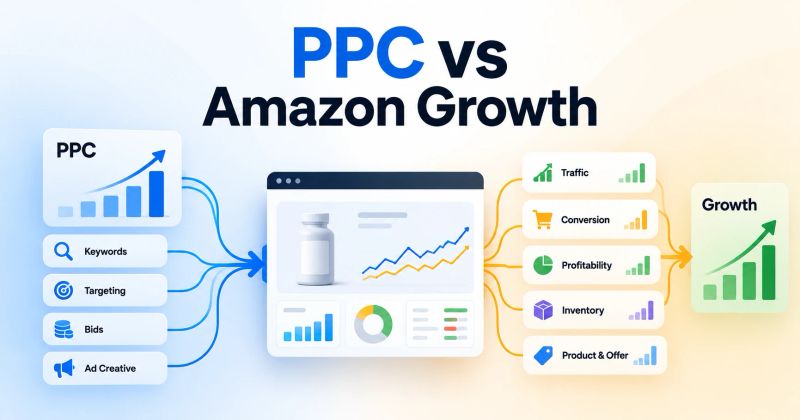
Amazon growth is therefore better understood as a business system:
Demand → Traffic → Conversion → Sales → Organic Visibility → Profit → Reinvestment
The job is to find the current constraint, remove it, and then find the next one.
What Does "Amazon Growth" Actually Mean?
Amazon growth is not one metric.
A brand can grow:
- Revenue
- Contribution
- Category share
- Customer acquisition
- Product portfolio
- Organic sales
- Total unit volume
Those objectives can require very different decisions.
A brand can increase revenue while becoming less profitable.
It can increase PPC-attributed sales without materially increasing total business sales.
It can increase branded sales while acquiring very few new customers.
Before deciding what to optimize, define what "growth" means for the business.
For most established brands, the objective is not simply:
More sales.
It is:
More valuable sales that the business can acquire, fulfill, and reinvest profitably.
1. Diagnose the Business Before Choosing the Channel
Start with the account and catalog, not the advertising console.
Look at five areas.
Product
Which ASINs have:
- Strong conversion
- Healthy contribution
- Meaningful demand
- Enough inventory
- Room to scale
Traffic
Are valuable searches receiving enough visibility?
Are you capturing relevant category demand, branded demand, and competitor demand?
Conversion
Are shoppers clicking but failing to buy?
Look at:
- Main image
- Images and video
- Title
- Bullet points
- A+ Content
- Reviews and rating
- Price
- Promotions
- Variation structure
- Featured Offer / Buy Box eligibility
- Fulfillment
- Offer competitiveness
A strong listing cannot compensate for an uncompetitive offer.
Economics
For important products, understand:
- Selling price
- COGS
- Amazon fees
- Fulfillment costs
- Promotions and discounts
- Return allowance
- Contribution before advertising
- Break-even ACoS
- Current ACoS
- Ad sales
- Organic sales
- Contribution after advertising
The exact contribution model varies by business, but it should consistently include the variable costs that change when another unit is sold.
Operations
Can the business support more sales?
Check:
- Inventory
- Replenishment lead time
- FBA availability
- Suppressed listings
- Seasonal constraints
- Promotions
This diagnosis prevents a common mistake:
Using one channel to solve a problem caused somewhere else.
2. Stop Treating Every ASIN Equally
Amazon catalogs are rarely economically balanced.
Suppose a brand has four products:
Product
Monthly Sales
Contribution Before Ads
Current ACoS
A
$120,000
32%
24%
B
$70,000
45%
19%
C
$35,000
18%
31%
D
$12,000
40%
52%
A basic sales report tells you Product A is the largest seller.
An operator asks:
Which product can absorb the next dollar of investment and produce a worthwhile outcome?
Product B may have more economic room for acquisition.
Product D may need a conversion or positioning fix before receiving more traffic.
Product C may have strategic value but little room for aggressive paid growth.
This is why growth planning should use product economics, not just revenue.
Add strategic importance to the decision
A product can be economically weak today but strategically important.
It may be:
- A hero product
- An entry product
- A customer acquisition product
- A cross-sell product
- A new category entry
- A seasonal product
So the decision should consider both:
Current economics + strategic role
Do not automatically cut an ASIN simply because its current contribution is lower.
3. Build a Profit Concentration Model
Rank products by contribution, not just sales.
Then divide the catalog into three practical groups.
Protect
Products with strong economics, reliable demand, and enough inventory to scale.
Develop
Products showing demand but requiring better traffic, conversion, positioning, or operational support.
Control
Products or initiatives consuming meaningful resources without producing enough commercial value.
The exact thresholds depend on the business.
The principle does not:
Investment should follow economic opportunity.
If a small group of ASINs produces most of the contribution, those products deserve disproportionate attention.
4. Find Out Whether the Problem Is Demand or Conversion
This is one of the first decisions to make.
If impressions and relevant traffic are weak, you may have a visibility problem.
If traffic is healthy but conversion is weak, you may have an offer or product-page problem.
If both are healthy but sales are still not scaling, investigate:
- Price
- Product-market fit
- Assortment
- Inventory
- Category constraints
- Competitive position
A simple diagnostic is:
Traffic problem: Not enough qualified shoppers reaching the product.
Conversion problem: Qualified shoppers arrive but do not buy.
Economics problem: Shoppers buy, but the economics do not support profitable acquisition.
Operations problem: Demand exists, but inventory or execution prevents the business from capturing it.
Do not jump to a PPC solution before deciding which of these problems you actually have.
5. Treat PPC as a Customer Research System
PPC is more than a traffic source.
It can also show you how customers describe the problem your product solves.
Suppose a product is positioned around:
"Premium insulated water bottle"
But converting searches repeatedly include:
"Water bottle for gym"
That is useful information.
Search-term data can reveal patterns in the demand you are actually capturing, including:
- Unexpected use cases
- Customer language
- Long-tail demand
- Important features
- New positioning opportunities
- Product ideas
- Competitor alternatives
That information can flow into:
- Titles
- Bullet points
- Images
- A+ Content
- Product positioning
- Keyword strategy
- Product development
The loop becomes:
PPC data → Customer insight → Listing/product improvement → Better conversion → Stronger economics
This is why PPC findings should not stay inside the advertising team.
For detailed PPC execution, see How to Optimize Amazon PPC Campaigns.
6. Separate PPC Growth From Total Business Growth
This distinction is important.
PPC-attributed sales are not automatically incremental business sales.
Advertising can:
- Capture existing branded demand
- Defend existing demand
- Shift customers between paid and organic results
- Expand into non-branded demand
- Introduce products to new shoppers
Those outcomes have different economic value.
For example, suppose PPC sales increase by $50,000.
That does not automatically mean the business gained $50,000 of incremental revenue.
You need to look at the broader picture:
- Total sales
- Organic sales
- Ad-attributed sales
- Branded sales
- Non-branded sales
- New-to-brand metrics where available
- Contribution
- Inventory
The question is:
Did advertising create additional business value, or did it primarily capture demand the brand was already receiving?
That is a much more useful growth question than simply asking whether PPC sales increased.
7. Improve Conversion Before Buying More Traffic
More traffic does not repair a weak offer.
Consider a simple example:
- 10,000 product-page visitors
- 5% conversion
- 500 orders
If conversion improves to 7% with the same traffic:
- 10,000 visitors
- 7% conversion
- 700 orders
That creates 200 additional orders without buying another visitor.
Before increasing traffic, check whether the page and offer deserve more of it.
Look at:
- Click-through rate
- Conversion rate
- Price competitiveness
- Review rating and recent review trends
- Main image
- Offer
- Content
- Customer objections
- Featured Offer eligibility
- Fulfillment
- Promotions
The growth decision can therefore be:
Improve the offer first. Scale traffic second.
8. Separate Demand Capture From Demand Creation
Amazon has customers already searching for products.
Advertising can capture that existing demand.
Brand growth can also involve creating awareness and consideration that did not previously exist.
Think about two different jobs.
Demand Capture
- Generic high-intent searches
- Branded searches
- Product targeting
- Bottom-funnel advertising
Demand Creation
- Brand discovery
- Video
- Display
- Brand Store experiences
- New-to-brand audiences
- Upper-funnel media
A smaller brand may concentrate heavily on demand capture.
A larger brand may justify a broader mix.
The important point is not to copy another brand's media mix.
Match the investment to the brand's stage, economics, objective, and ability to convert the demand it creates.
For the execution layer, see Amazon PPC Campaign Structure.
9. Concentrate Investment Behind Proven Opportunities
A common account-management habit is distributing budget evenly.
Real demand is rarely evenly distributed.
Look for:
- Products producing strong contribution
- Search themes producing repeatable sales
- Traffic sources with acceptable economics
- Campaigns consistently constrained by budget
- Products with enough inventory to absorb additional demand
Then protect those opportunities.
At the same time, control initiatives that repeatedly consume resources without producing enough commercial value.
This does not mean shutting down everything with a high ACoS.
If ACoS is the specific problem you are trying to solve, see How to Lower ACoS on Amazon for the detailed optimization process.
It means deciding what job each investment is supposed to perform.
10. Think in Incremental Dollars, Not Historical Winners
The biggest ASIN is not automatically the best place for the next dollar.
Historical performance tells you what has already happened.
Growth planning needs another question:
What is the likely value of the next dollar?
Consider two campaigns:
Campaign A
- $10,000 spend
- $40,000 ad sales
- 4.0 ROAS
Campaign B
- $5,000 spend
- $20,000 ad sales
- 4.0 ROAS
Historical ROAS is identical.
But that does not mean the campaigns have identical scaling potential.
Campaign A may already be heavily funded.
Campaign B may have more available demand.
The next $1,000 could therefore have a different outcome in each campaign.
This is why experienced operators look beyond historical averages.
They consider:
- Budget constraints
- Recent performance
- Conversion rate
- CPC
- Impression opportunity
- Search demand
- Placement performance
- Product economics
- Inventory
- Competitive conditions
Historical ROAS tells you what the existing budget produced. It does not tell you what the next dollar will produce.
11. Treat Organic Visibility as Part of the Growth Equation
Paid and organic performance should not be treated as completely separate.
Advertising can expose a product to additional relevant shoppers.
Search and sales data can also identify queries and product themes worth addressing through listing optimization.
A useful growth question is:
Where does paid visibility create incremental value, and where are we already getting strong organic coverage?
This changes how you evaluate advertising.
The goal is not to maximize paid sales in isolation.
The goal is to improve the total business outcome.
12. Use Product Assortment as a Growth Lever
Growth does not always come from squeezing another percentage point out of an existing campaign.
Sometimes the larger opportunity is the catalog.
Look for:
- Adjacent products
- Different pack sizes
- Price points missing from the assortment
- Variations customers are already asking for
- Complementary products
- Products that can increase customer lifetime value
Your existing PPC and search data can help identify these opportunities.
If customers repeatedly search for a use case that the catalog does not serve well, that is potentially a product strategy signal.
Advertising data can therefore influence what the brand sells next, not just how it advertises what it sells today.
13. Protect Products That Can Actually Scale
Advertising cannot manufacture inventory.
If a product repeatedly goes out of stock, aggressive traffic generation can create a short-term sales spike followed by lost momentum.
Before increasing investment, check:
- Current inventory
- Replenishment lead time
- Sales velocity
- Expected advertising lift
- Promotions
- Seasonal demand
More importantly, estimate the effect of the advertising change.
If an additional $10,000 of advertising is expected to increase daily unit velocity materially, compare that expected demand with:
- Current weeks of cover
- Inbound inventory
- Supplier lead time
- FBA availability
A strong PPC opportunity can still be the wrong growth decision if the product cannot remain available.
Growth has to be operationally executable.
14. Manage Branded and Non-Branded Growth Separately
Branded demand and non-branded acquisition answer different business questions.
Branded advertising can protect existing demand.
Non-branded advertising attempts to acquire customers from category demand.
If the two are mixed together, acquisition performance can look healthier than it really is.
Where the data allows, separate:
- Branded sales
- Non-branded sales
- Branded ACoS
- Non-branded ACoS
- New customer acquisition
- Organic contribution
Then ask:
How much of our growth is coming from customers who were already looking for us?
That answer matters when deciding whether advertising is actually expanding the business.
15. Change the Growth Strategy as the Product Matures
A new product should not be managed like a mature bestseller.
Launch Stage
Primary questions:
- Can we generate initial demand?
- Which customer searches convert?
- Is the offer competitive?
- What objections are appearing?
- Which signals justify further investment?
Traction Stage
Primary questions:
- Which demand pockets are becoming reliable?
- Where should budget increase?
- Which products are showing strong economics?
- Which constraints are holding growth back?
Scale Stage
Primary questions:
- Where can incremental spend still produce worthwhile returns?
- Can the product support more demand?
- Which adjacent searches and products can expand the market?
- How much should be reinvested versus retained as contribution?
The strategy changes because the constraint changes.
16. Use Amazon's Data Before Buying More Software
Sophisticated growth does not require collecting every possible report.
Depending on the account and programs available, useful data can include:
- Search term reports
- Targeting reports
- Placement reports
- Advertised product reports
- Performance over time
- Purchase product reports
- Brand metrics
- Search Query Performance
- Amazon Pi for eligible Amazon India brands
The important question is:
What decision will this data change?
If a report does not change a decision, it probably does not deserve regular management attention.
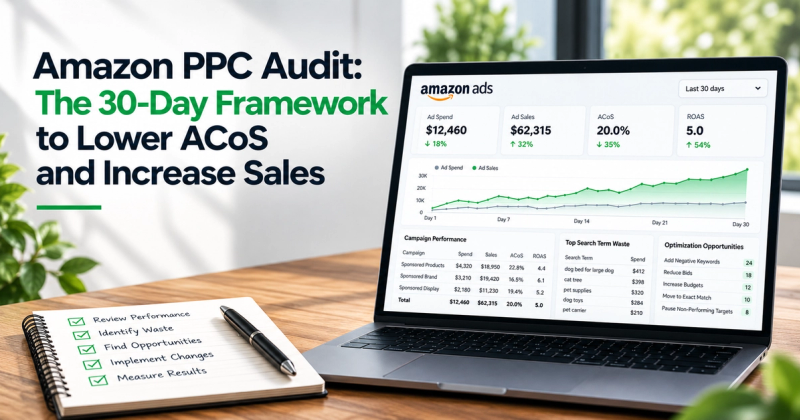
For detailed advertising execution and account diagnosis, see Amazon PPC Audit.
17. Build a Growth Scorecard Around Decisions
A useful weekly scorecard does not need to contain every metric available.
Track:
Area
Question
Revenue
Is total sales growing?
Profit
Is contribution after advertising improving?
Traffic
Are valuable searches getting enough visibility?
Conversion
Are shoppers buying at an acceptable rate?
PPC
Is paid spend achieving its intended objective?
Organic
Are important searches gaining visibility?
Product
Which ASINs deserve more investment?
Inventory
Can the winners remain in stock?
Acquisition
Are we expanding beyond existing brand demand?
Then identify the one to three biggest constraints for the next period.
That is more actionable than reporting every metric simply because the dashboard contains it.
18. Worked Example: A $500K/Month Amazon Brand
Consider a hypothetical brand doing approximately $500,000 per month.
The account looks healthy at first.
- Total sales: $500,000
- Advertising spend: $100,000
- Ad-attributed sales: $350,000
- Several ASINs are generating strong revenue
- PPC ROAS appears acceptable
A superficial analysis might recommend:
Increase advertising.
An operator would look deeper.
Step 1: Examine contribution
Three ASINs produce approximately 75% of the catalog's contribution.
Those products deserve more attention than the rest of the catalog.
Step 2: Check inventory
One hero ASIN has only five weeks of cover.
Aggressively increasing advertising on that product could create a supply problem.
Step 3: Examine conversion
Two other products have substantial traffic but weak conversion.
Those products may have an offer, price, content, review, or product-positioning problem.
Sending more traffic before addressing that issue could increase wasted spend.
Step 4: Separate branded demand
A meaningful portion of PPC sales comes from branded searches.
That means the headline PPC sales number may overstate the amount of incremental customer acquisition.
Step 5: Examine non-branded demand
Several non-branded search themes show consistent sales and acceptable economics.
Those may provide a more useful expansion opportunity.
Step 6: Reallocate
Instead of increasing every campaign:
- Protect the profitable hero products.
- Avoid aggressive scaling where inventory is constrained.
- Improve conversion on high-traffic products.
- Separate branded and non-branded performance.
- Increase investment where non-branded demand is proven.
- Reduce funding from persistent underperformers.
- Reassess total contribution after the changes.
The important point is that the growth strategy came from diagnosing the business, not from looking at one PPC metric.
A Practical Amazon Growth Operating Model
A useful operating loop is simple.
1. Find
Identify the biggest economic constraint or opportunity.
2. Diagnose
Determine whether the cause is:
- Demand
- Traffic
- Conversion
- PPC
- Product economics
- Inventory
- Positioning
- Assortment
- Operations
3. Quantify
Estimate what solving the problem could be worth.
For example:
- How much additional revenue could the product support?
- How much contribution could be created?
- How much traffic is currently being lost?
- How much inventory is available?
- How much investment is required?
4. Prioritize
Choose the few actions with the strongest potential impact.
5. Execute
Make the change and define what success should look like.
6. Measure
Give the change enough data to evaluate it properly.
7. Reallocate
Move budget, attention, inventory, and resources toward the opportunities that prove themselves.
This is the difference between managing Amazon activity and managing Amazon growth.
When Should You Use Amazon Growth Services?
An Amazon growth partner can be useful when the account has enough complexity that important decisions are being missed.
Typical signs include:
- Advertising spend is significant but optimization is reactive
- Multiple ASINs compete for limited budget
- Sales are growing but profit is not
- PPC and listing work are managed separately
- Search-term data is not reaching the content or product team
- Inventory and advertising decisions are disconnected
- The founder is manually reviewing large amounts of account data
- The brand is entering a new category or marketplace
- There is no clear system for prioritizing opportunities
The value of a growth service should not be measured by how many reports are delivered.
It should be measured by the quality of the decisions and execution it creates.
What to Look for in an Amazon Growth Partner
Before hiring an agency, ask:
- 1How do you decide where to invest more money?
- 2How do you evaluate product-level economics?
- 3How do you identify the biggest growth constraint?
- 4How do PPC findings influence listing and product decisions?
- 5How do you handle products with different margins?
- 6How do you distinguish branded demand from customer acquisition?
- 7How do you account for inventory when scaling?
- 8How do you decide whether a high ACoS is actually a problem?
- 9How often do you reprioritize the account?
- 10Can you show the decisions behind your recommendations, not just the dashboard?
These questions reveal whether a provider is primarily managing campaigns or thinking about the business.
How SellerRoot Approaches Amazon Growth
Most Amazon growth programs begin with a channel.
SellerRoot begins with the opportunity inside the account.
SellerRoot's core strength is the advertising and account-performance layer of this growth system.
It helps brands identify opportunities across:
- Campaigns
- Targets
- Search terms
- Bids
- Budgets
- Product performance
- Advertising efficiency
- Account-level trends
The objective is not to produce more recommendations.
It is to identify the decisions that can materially change the business.
The question is:
Where is the next meaningful improvement hiding?
It could be wasted advertising spend.
It could be a product that deserves more investment.
It could be a search theme revealing customer demand.
It could be a conversion problem that should be fixed before traffic is scaled.
It could be an inventory constraint preventing a strong product from growing.
The operating loop is:
Find the opportunity → Understand the cause → Quantify the opportunity → Prioritize the action → Execute → Measure → Reallocate
That keeps Amazon advertising connected to the broader growth problem.
If you want an operator-led approach to identifying and prioritizing these opportunities, see Amazon Growth Services.
Final Takeaway
Amazon growth is rarely one clever PPC tactic.
It is a sequence of better business decisions.
The strongest operating model connects:
Demand + Traffic + Conversion + Advertising + Organic Visibility + Products + Inventory + Economics
If sales are not growing, the first decision is diagnosis, not a higher bid.
Find the constraint.
If sales are growing but profit is falling, do not judge the business by revenue alone.
Find where the economics are breaking.
If PPC is producing valuable search and customer data, do not leave that information inside the advertising console.
Use it to improve the listing, product strategy, and next investment decision.
If advertising sales are growing, determine whether the business itself is growing or whether advertising is primarily capturing demand that already existed.
The goal is not simply to run more Amazon ads.
It is to build a system that consistently answers one question:
Where should the next dollar, hour, and unit of inventory go to create the most valuable growth?
That is the foundation of a repeatable Amazon growth strategy.
Key takeaways
- Amazon growth is not the same as increasing sales or advertising spend.
- Experienced operators find the account's biggest constraint before deciding which channel to invest in.
- Product economics should influence PPC budgets, campaign priorities, and scaling decisions.
- PPC search-term data can improve listings, positioning, product decisions, and organic strategy.
- The right Amazon growth partner should help identify and execute the few decisions that can materially change the business.
Frequently asked questions
An Amazon growth strategy is a coordinated plan for increasing sales, market share, and profit by improving traffic, conversion, advertising, organic visibility, product economics, inventory, and product assortment.
About the author

Amazon Ads operators
Yogendra Kashyap is the Founder of SellerRoot and an Amazon Ads expert with 9+ years of experience helping brands grow through data-driven advertising. His expertise spans Amazon PPC, campaign optimization, search term analysis, and marketplace growth. Together with the SellerRoot team, he is building AI-powered tools for Amazon advertisers while sharing practical, experience-backed insights to help brands improve profitability and scale on Amazon.
Looking for the next growth opportunity in your Amazon business?
SellerRoot helps Amazon brands identify and prioritize opportunities across advertising, search terms, campaigns, products, and account performance.